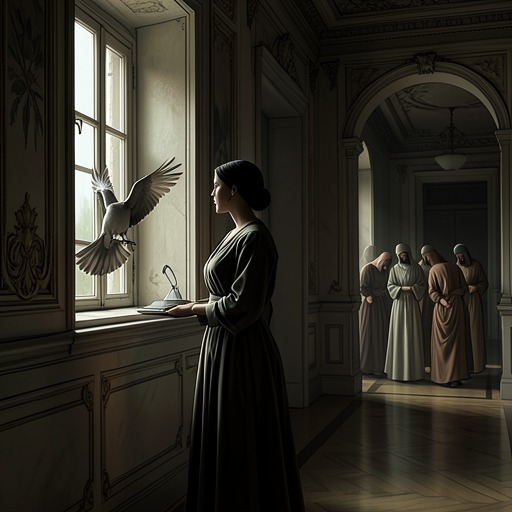
The storm-night palanquin switch
Ponniyin SelvanThe storm-night palanquin switch is a covert exchange between Poonguzhali and her aunt, Mandhakini, who has been mistaken for the Pazhuvoor Ilaiya Rani. Recognizing one another in a lightning-lit instant, they communicate in darkness and reverse their places: Poonguzhali enters the palanquin, while Mandhakini leaves with Amudhan. The maneuver gives Mandhakini a way to evade those holding her and, as Poonguzhali understands it, an opportunity to discover who they are; it also sets up a later separation amid the turmoil at the fort.
The Palanquin and the Mistaken Identity
The exchange begins at a mandapam where Amudhan and Poonguzhali have been watching a palanquin arrive. As lightning briefly illuminates the scene, two men lift it and bring it to the entrance. Poonguzhali jokes that the Pazhuvoor Ilaiya Rani seems eager to encounter them, but Amudhan tries to draw her farther inside the mandapam. She resists. Their attention remains on the palanquin, leaving them unprepared for what its passenger will reveal.
Another flash shows a woman parting the screen and looking directly toward them. The woman appears to recognize them, and a smile forms on her lips. Darkness returns almost immediately, but Poonguzhali is certain she has identified the passenger: it is not the Pazhuvoor Ilaiya Rani, but her aunt, Mandhakini. The brief glimpse overturns their assumption about who is travelling in the palanquin. It also makes the arrival a matter of family recognition and possible rescue, rather than merely an encounter with the queen they had expected.
The Exchange in Darkness
Before Poonguzhali and Amudhan can decide what to do, the screen opens wider and someone steps out. Moving cautiously and silently, Mandhakini crosses to them without attracting the sentries’ attention. Poonguzhali recognizes her aunt in the darkness. Mandhakini takes both their hands and leads them toward the rear of the mandapam, where she embraces Poonguzhali and presses a kiss to her forehead. The reunion is wordless in speech but not in communication: the two women exchange news through signs, discerning one another in the dark.
Mandhakini then gives them a practical instruction. Poonguzhali is to enter the palanquin; Amudhan is to escort Mandhakini to his home. Poonguzhali accepts the arrangement as a ruse for discovering the identity of the people who have taken her aunt. Amudhan cautions that a plan can carry risks as well as promise a solution. Poonguzhali answers that she does not expect to be harmed, but points to the knife at her waist as a safeguard if the danger comes. The exchange is thus not simply a disguise: it depends on the women’s quick recognition, their ability to communicate without speech, and Poonguzhali’s willingness to take the place of the apparent captive.
Poonguzhali embraces Mandhakini, then approaches the palanquin on noiseless feet and climbs inside. She draws the silk curtains closed. In the darkness, the sentries have seen nothing; the woman they might have expected to remain in the palanquin has left, while Poonguzhali has taken her place. Mandhakini and Amudhan can depart together without the exchange being witnessed. The curtains conceal the substitution, but the plan also leaves Poonguzhali exposed to whatever awaits the palanquin at its destination.
The Plan’s Immediate Stakes
The switch changes who is visible and who can move freely. Poonguzhali’s earlier suspicion that Mandhakini was being held by captors now shapes her reading of the plan: taking the palanquin may allow her to approach those people and learn their identity. That objective is her stated understanding of Mandhakini’s strategy, rather than a motive independently explained by Mandhakini. Amudhan’s warning marks the uncertainty at the heart of the maneuver: the substitution may create an opening, but it may also place Poonguzhali in danger.
The episode’s suspense rests on a sequence of limited glimpses: lightning reveals the passenger; darkness hides the exit; signs carry the instructions; and the closed curtains complete the substitution. No public explanation is offered and no one is shown discovering the switch at the mandapam. Instead, the exchange depends on the contrast between the palanquin’s visible, guarded arrival and the quiet movement that changes its occupant. The concealed action gives Mandhakini a route away from the immediate scene, while Poonguzhali knowingly takes on the uncertainty attached to the vehicle.
Aftermath and Significance
The later consequences show that the change of places does not resolve Mandhakini’s situation. The night’s storm has damaged Amudhan’s home, including a tree that fell onto its roof, and Amudhan is confined to bed with a fever when Poonguzhali and her escort arrive there with Mandhakini. Poonguzhali persuades her aunt to go to the fort by explaining that the ailing Sundara Chozhar wishes to see her and that Kundhavai is waiting to accompany her to him. Mandhakini agrees to travel with Poonguzhali and Azhwarkkadiyaan. This later journey is separate from the exchange at the mandapam, but it continues the pattern of movement, concealment, and uncertain protection that the switch set in motion.
At the fort, Mandhakini enters with a crowd instead of taking the secret passage that Azhwarkkadiyaan recommends. People begin to remark on her resemblance to the Pazhuvoor Ilaiya Rani, prompting Poonguzhali and Azhwarkkadiyaan to push through the crowd and shield her. The Velakkara Regiment separates them from Mandhakini as it intervenes. A confrontation then erupts between the regiment and Pazhuvoor soldiers; when Chinna Pazhuvettarayar rides into the street, the crowd scatters and the soldiers regroup around him. In the confusion, Poonguzhali and Azhwarkkadiyaan discover that Mandhakini has vanished, and their search nearby finds no trace of her. The palanquin substitution is therefore one moment in a continuing effort to protect and locate Mandhakini: it succeeds in moving her out of the mandapam unseen, but does not secure her safety or a lasting reunion with her niece.